Modern financial institutions no longer suffer from slow payment rails, but they do suffer from delayed data intelligence. By the time data is enriched and an alert reaches the fraud team, the payment may have already cleared, the customer may be frustrated, and trust may already have taken a hit. That visibility gap is becoming a serious problem for banks that still rely heavily on enriching transaction data in legacy batches.
Historically, reviewing transactions at scheduled intervals rather than in real-time made sense. It allowed banks to manage growing transaction volumes while maintaining stable payment processing operations across legacy infrastructure.
The problem is that modern fraud moves faster than those systems were designed to handle. Fraud patterns are now rapid, distributed, and increasingly difficult to identify after the event.
Real-time fraud detection now matters more than ever
Authorised push payment fraud losses alone reached hundreds of millions of pounds in 2025, with criminals continuing to exploit delays in detection and response.
The challenge is not just about mitigating financial loss but also about managing heightened consumer and regulatory expectations. Customers shaped by instant transfers, real-time spending alerts, and digital wallets expect banks to recognise suspicious behaviour immediately. When a bank reacts hours later, it creates immense pressure on fraud teams to move faster, often forcing them to make critical decisions based on delayed or poorly enriched data.
With accurate, real-time transaction categorisation and enrichment, banks can assess spending behaviour as it happens, giving fraud systems stronger signals instantly rather than after the event.
This real-time analysis helps banks identify suspicious activity almost immediately while allowing fraud analysts to apply account protection measures with greater confidence.
The outcome is not just faster fraud detection. It is a stronger customer relationship built on timely action, fewer unnecessary disruptions, and greater trust in the bank’s protection of customer finances.
What’s the difference between batch-processed data intelligence and real-time transaction enrichment?
At a high level, the difference comes down to when the bank understands what is happening.
With batch processing, transactions are grouped together and enriched at scheduled intervals. That might happen every few hours, overnight, or at another fixed point during the day.
With real-time enrichment, transactions are assessed as they happen. That difference affects far more than speed.
It changes how quickly fraud can be identified, how confidently account protection measures can be applied, and the type of experience customers have with the bank when suspicious activity occurs.
Batch processing works retrospectively
Traditional transaction processing systems were designed for stability and scale.
Processing transactions in batches helped banks manage large volumes efficiently. However, the downside to this method is the lack of real-time visibility.
If suspicious behaviour like card testing happens between processing windows, fraud systems may not recognise the pattern until long after the payment has cleared.
This creates several operational challenges:
- Fraud teams investigate activity after losses occur
- Customers discover fraud before the bank does
- Account protection measures become more reactive
- Delayed data processing increases false positives and unnecessary payment blocks
The model is built around hindsight. That becomes increasingly difficult in a payments environment where customers expect immediate action.
Real-time processing works during the transaction
With real-time processing, transactions are assessed continuously as they move through the system.
That allows banks to:
- Identify suspicious behaviour earlier
- Apply account protection measures faster
- Confirm unusual spending directly with customers
- Reduce unnecessary friction caused by incomplete information
When fraud detecting platforms receive richer transaction categorisation and enrichment context in real-time, they can make better decisions. At the same time, the payment is still in motion rather than relying on delayed reviews.
This is how real-time payments are increasing pressure on banks to modernise fraud controls and reduce detection delays – with customer expectations also continuing to shift.
The difference is easier to see side by side:
| Feature | Batch payment processing | Real-time processing |
| Fraud detection | After the transaction clears | During the transaction |
| Customer engagement | Reactive | Immediate |
| Account protection measures | Delayed | Faster and more targeted |
| Data processing | Scheduled intervals | Continuous |
| Visibility into suspicious behaviour | Limited by processing windows | Ongoing |
| Customer experience | Frustration after the event | Faster reassurance |
| Fraud response | Recovery-focused | Prevention-focused |
This does not mean batch systems no longer have a role. Many banks still rely on them for reconciliation, reporting, and operational processing, but they can no longer form the foundation of modern fraud defense.
What are the fraud risks of batch processed data intelligence?
The issue with batch processed data intelligence is not simply its age, but its foundational design. Built for an era of overnight settlement windows, batch processing the enrichment of transaction data inherently creates a critical structural delay.
In an ecosystem where fraud moves across accounts, devices, and payment rails in milliseconds, relying on delayed transaction enrichment cycles, forces fraud teams to operate in retrospect.
With the rise of AI, criminals are increasingly exploiting the gap between faster payment systems and delayed detection windows. At the same time, reimbursement requirements introduced by the Payment Systems Regulator have increased the financial consequences of delayed intervention in authorised push payment fraud cases.
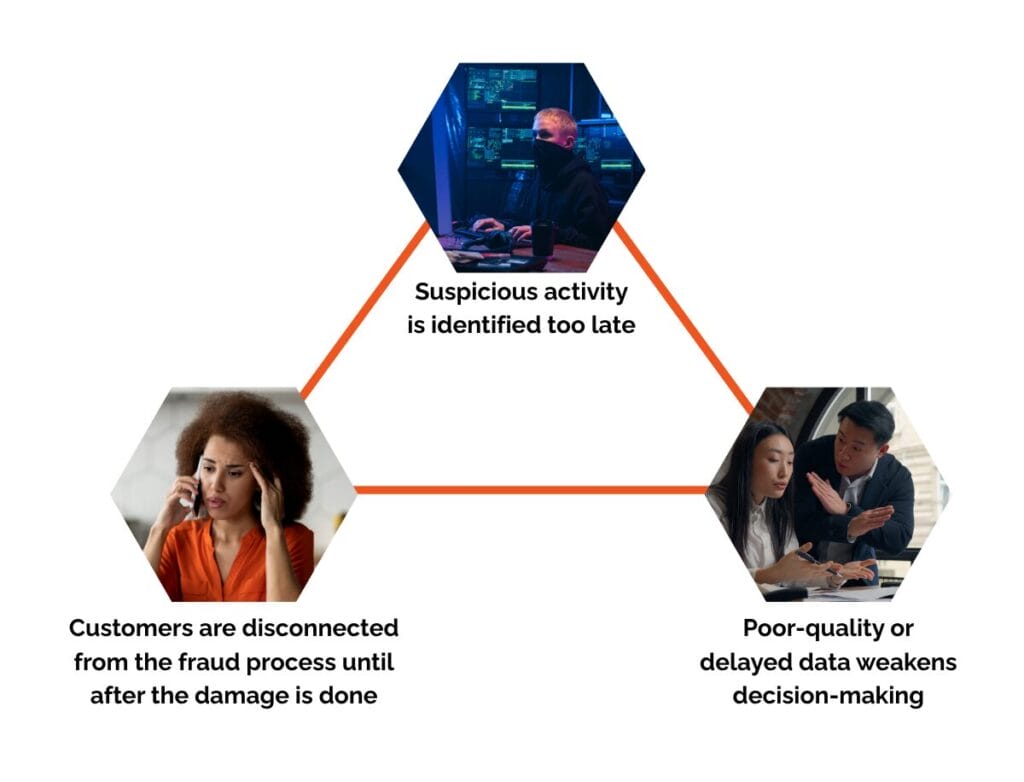
That creates three consistent risks:
- Suspicious activity is identified too late
- Poor-quality or delayed data weakens decision-making
- Customers are disconnected from the fraud process until after the damage is done
It’s too slow; you’ll miss the signals
The biggest weakness in delayed transaction enrichment is timing.
By the time an alert is reviewed, the money may already have left the account.
As instant payments become more common, fraudsters can move stolen funds across multiple accounts before intervention begins. Industry analysis from UK Finance highlights how criminals increasingly exploit faster payments to move stolen funds before banks can respond effectively.
Mastercard has also warned that the gap between data compromise and fraud monetisation is often less than 24 hours, leaving little room for delayed reviews.
One increasingly common example is card cracking. Fraudsters test stolen card details with small purchases before rapidly draining funds through repeated transactions. By batch processing enrichment, banks effectively take themselves out of the race in terms of spotting the signals of card cracking, with an overwhelming likelihood of identifying suspicious behaviour after the fact.
The opposite: accurate transaction categorisation and enrichment during live payment processing, enables earlier identification of this behaviour earlier. It gives fraud analysts a stronger chance to intervene before losses escalate while applying account protection measures with greater confidence.
Vague data stalls account protection measures
The challenge is not simply speed, but visibility and transparency. With batch processed enrichment leaving a window where the data is vague, it effectively disables both automated fraud systems, and human analysts from taking any account protection actions, until they have greater insight into the data.
Account freezes, payment reversals and cardlock mechanisms are all available, but feel out of reach until analysts can confidently identify signs of payment fraud. Taking this action too early can lead to false positives – frustrating customers with genuine payment needs, and even placing their accounts into vulnerable circumstances if these measures are taken on an unwarranted basis.
With richer, real-time transaction categorisation and enrichment, banks can strengthen fraud detection using live data signals from open banking, open finance, proprietary datasets, and existing bank transaction data.
It gives a better context to identify suspicious behaviour earlier, while helping teams apply account protection measures with greater confidence.
This is where Moneyhub supports banks. Rather than replacing existing fraud infrastructure, the Categorisation and Enrichment Engine injects real-time context into live payment processing. By transforming raw transaction data into instant, actionable insights, we help banks step out of recovery mode and into true, real-time fraud prevention, protecting both the consumer’s financial well-being and the bank’s commercial primacy.
Delayed fraud detection is becoming a customer trust problem
Customers can freeze cards instantly, receive spending notifications immediately, and move money in seconds. They increasingly expect fraud systems to respond at the same speed.
But when banks rely heavily on delayed transaction enrichment, fraud teams are often forced into recovery mode rather than prevention. This usually creates a domino effect of financial loss, operational pressure, and frustration for customers who expect faster transaction fraud detection from their bank.
Falling victim to fraud can be a devastating life event, with many consumers unable to get their funds back. To be the bank associated with such an experience often leads to reputational damage, with high switch rates and negative sentiment.
Real-time transaction enrichment enables institutions to stay on the right side of the fraud, whether that’s in:
- Applying account protection measures in true cases of suspicious activity
- Leaving accounts alone when these actions would be unwarranted
By working with the categorisation and enrichment data in real-time, banks can strengthen their fraud detection measures, and their customer relationships.
About Matt Barr
Matt Barr is a Product Director here at Moneyhub. He’s been working either with or for banks since the mid-00s, solving all manner of problems. From ISA transfers to corporate actions, Matt now focuses on transaction categorisation and enrichment. When he’s not solving client problems, you can find Matt buried under his children’s laundry or stomping through the Peak District.
share