With large-scale financial institutions processing approximately 1.51 million credit card transactions every minute, there are bound to be a few thousand that are wrongly flagged as fraud. In this day and age, they’re generally accepted as a necessary inconvenience – a side effect of true fraud detection.
But what if we told you that by reducing your false positives, you could be retaining more customers, generating higher lifetime value, and reducing the direct cost associated with dispute investigation? All without missing the true cases of fraudulent spending.
In this piece, Product Director Matt Barr, explains why the best of both worlds: powering accurate fraud detection while flagging fewer false alerts, should be the goal.
How do false positives in transaction fraud monitoring occur?
Incomplete data and poor data quality are the top causes of false positives for transaction fraud.
This could be because the data is not enriched, or has become siloed in legacy technology. As Matt highlights, “when data’s siloed, it loses context“. And this is agreed upon in academic settings too, with one study highlighting, “transactions are only relevant in the context of other transactions”.
When these all-important transactions are missing key enrichment factors like correct merchant names, accurate categories or precise locations, the entire fraud detection algorithm becomes less reliable. And this is what causes a high number of false positives. Both machines and teams are forced to make decisions around what looks suspicious, based on only half of the full picture.
Compound that with fraud techniques like card testing, and the risk grows further. With more than four in five financial services leaders citing data quality as a top challenge, it’s likely that teams across the industry are feeling the effects of this challenge in fraud detection and elsewhere.
What are some of the arguments for false positives?
Some advocate for false positives as a useful training tool to practice transaction fraud detection. After all, if you’re catching all of the true fraud cases, are false positives really that bad?
While this idea has some force, the counterargument is a much worse reality for banks – alert fatigue. Because if employees are aware that there is a 95% probability of the next alert being illegitimate, they’re far less likely to take it seriously. And worryingly, it seems like alert fatigue is already settling in, with compliance officers admitting that investigations are far more time-consuming than they are challenging.
Others argue that false positives reassure regulators. After all, the Federal Reserve acknowledges that, “all models have some degree of uncertainty and inaccuracy”, implying they expect to see at least some false positives reported.
But as Matt comments,
“95% is not ‘some’, it’s dramatically more work than required”.
If only 5% of the alerts are legitimate, the manual investigation costs for 19/20 alerts are completely unnecessary. Reducing this figure would not change the bank’s ability to meet regulatory expectations or to identify transaction fraud in real-time, but it would prevent the wastage of resources.
‘Better false positives than false negatives’ is another common mindset. This has merit, especially as the penalties for missing fraudulent transactions increase – UK banks were mandated to reimburse automated push payment fraud victims £27 million last year alone.
However, under Consumer Duty, firms have a mandate to act in good faith and prevent foreseeable harm. A false positive that results in a wrongful account freeze isn’t just a technical glitch, especially if it prevents a customer from paying their bill on time, or going into an overdraft. It’s a failure to deliver a good customer outcome.
The same data silos and batch processing systems generating excessive false positives are also more likely to produce false negatives. It proves that legacy systems and poor data quality are not fit for purpose in either direction under modern regulatory scrutiny.
What is the impact of false positives on banks?
The mounting backlog of false positive investigations means banks have less time to focus on new emerging risks. It’s worrying for front, middle and back offices.
In the following sections, we’ll dive deeper into the effects on operational efficiency, budgets and customer relationships.

What is the impact of false positives on operational efficiency?
Matt highlights how devastating false positives can be for operational efficiency:
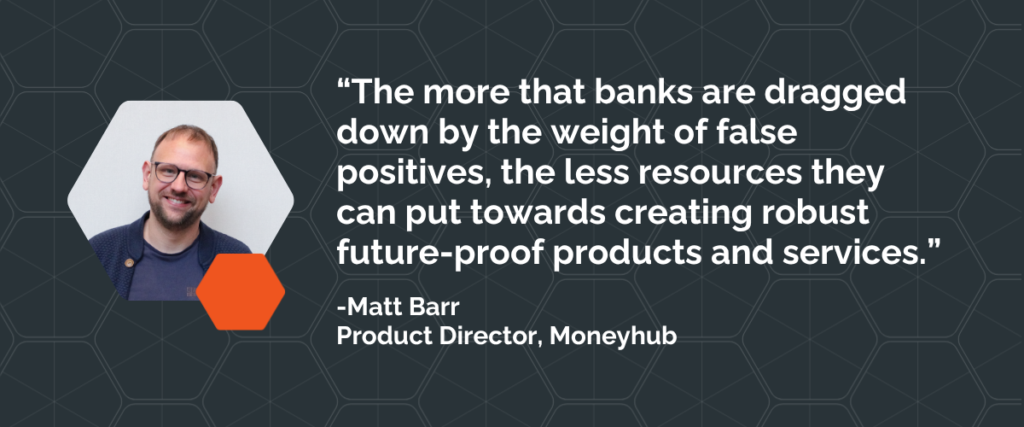
“Banks need breathing room, not only to anticipate new cyberthreats, but also to innovate for their customers”, he comments. “The more they are dragged down by the weight of false positives, the less resources they can create robust future-proof products and services”.
What is the impact of false positives on budgets?
The obvious answer is in headcount, with more false positives requiring a higher volume of investigations, often only possible through hiring a larger team.
But beyond that, it’s a financial institution’s customer service centre that comes under the most pressure. Matt elaborates, “around one in five calls to customer service are queries about genuine transactions. But many of these could be completed avoided, by putting clearer transaction data in the hands of the customer and fraud analysts alike.”
With each investigation taking time to sort through, it’s easy for banks to create a backlog, leading to further customer dissatisfaction. And at a cost of approximately £7.20 per investigation, how much could you save with faster transaction fraud detection?
At a rate of just 100 false positives per day, far below current estimates, the investigational cost alone is over £260,000 per year.
What is the impact of false positives on the customer relationship?
For customers, the impact of their bank finding a fraudulent transaction is often a payment block or an account freeze – annoying, but if it’s done to protect their account from fraudsters, it’s usually forgivable.
Finding out that the transaction in question isn’t actually fraud at all, however, can turn that reaction on its head. Matt notes,
“Wrongfully-applied account controls directly affect customer sentiment, and just one false positive can be all it takes to cause that customer to open a primary account elsewhere”
Add in the fact that applying these incorrect controls can cause customers to miss key payments or dip into overdrafts to afford expected bills, and this has huge implications around Consumer Duty. Alongside direct regulatory consequences, the financial anxiety caused by unnecessarily placing your own customer into vulnerable circumstances destroys the customer relationship.
Even asking customers to provide additional information creates a huge amount of customer dissatisfaction. One in five customers are now leaving their banks because of slow or frustrating service.
You don’t have to accept false positives
A high false positive rate is a sign that the current system of poor quality and siloed data is not working. Maintaining this system with hundreds of additional fraud analysts at a cost of £7.20 per investigation rapidly burns through budgets. But it doesn’t necessarily lead to better results. Instead we’re seeing increased alert fatigue and customer dissatisfaction.
Meanwhile, fraudsters are already experimenting with new attacks. With mounting false positives, banks are ill-prepared to deal with them and struggle to identify fraudulent transactions in real-time.
About Matt Barr
Matt Barr is a Product Director here at Moneyhub. He’s been working either with or for banks since the mid-00s, solving all manner of problems. From ISA transfers to corporate actions, Matt now focuses on transaction categorisation and enrichment. When he’s not solving client problems, you can find Matt buried under his children’s laundry or stomping through the Peak District.
share