
TL;DR: Providers are under increasing pressure to deliver better member journeys. Sarah Farrier, Product Manager at Moneyhub, shares the smart way to build them faster: widgets.
Pension providers are under huge pressure to deliver more relevant, useful member experiences. The Pensions Regulator wants providers to “make better and more systematic use of the data they have to better understand their savers’ characteristics and circumstances”. At the same time, Pensions Dashboards, Consumer Duty changes and Targeted Support reforms raise sector expectations higher.
Employers, advisers and scheme decision-makers are increasingly looking beyond price alone when they assess pension propositions. The Value for Money framework reflects that shift, with a clear focus on investment performance and service quality, supported by the Financial Conduct Authority (FCA), The Pensions Regulator (TPR) and Department for Work and Pensions (DWP).
Independent Pensions Policy Institute research also suggests provider engagement strategies need to be more tailored and strengthened to member needs, with digital channels becoming “an increasingly important component” in a provider’s approach.
Key takeaway: providers are under growing commercial pressure to offer journeys that are clear, usable and genuinely helpful. Providers that build stronger everyday relationships with members are better-placed to stand out in a competitive market.
The problem: the snail’s pace of delivery holds providers back
The challenge is not limited to identifying how member experience could best improve. It is getting those changes live at an acceptable pace. In this piece, I’m exploring why that delivery gap persists, where lower-effort solutions can help, and which rollout approach is most likely to get useful journeys live in weeks, not years.
The Pensions Regulator believes that many schemes have traditionally underinvested in data. While many providers are still working through data modernisation programmes, regulatory change and dealing with operational pressures which make it harder to launch better member experiences quickly. This leaves the sector in ‘data debt’.
The result is that packed roadmaps, complex governance, regulatory pressures, legacy systems, and long development cycles make even strong member propositions difficult to go live. A useful idea can win support in principle, but still take months, if not years, to reach production. By then, momentum has often gone.
The best solutions give pension teams a practical route to launch low-risk, impactful features in weeks, not years. By working with specialist partners to deploy embedded solutions, providers can reduce delivery friction, bring value to market faster, test demand earlier, and build a stronger internal case for wider investment.
How can pension providers launch new features while balancing speed, control and effort?
The frustrating part about solving this problem is that there is no single correct solution for pension providers.
The most suitable approach depends on the balance each organisation wants to strike between speed, control and internal delivery effort. The most optimal approach may be:
- A full white-label solution, built by specialist suppliers, offers the fastest route to market, but gives the client less direct control.
- An API approach where clients consume external data services then build their own UX on top offers clients the most control, but often takes the longest because it depends on their own internal design, engineering, and delivery capacity.
Fortunately, widgets – also known as embedded solutions – are another option which sit neatly between those two extremes.
What are widgets?
Widgets are customisable tools that plug directly into a client’s own IT estate. They offer a practical balance of speed, lower delivery effort and a high degree of branding control. As part of the Moneyhub solution, we offer a comprehensive library of widgets.
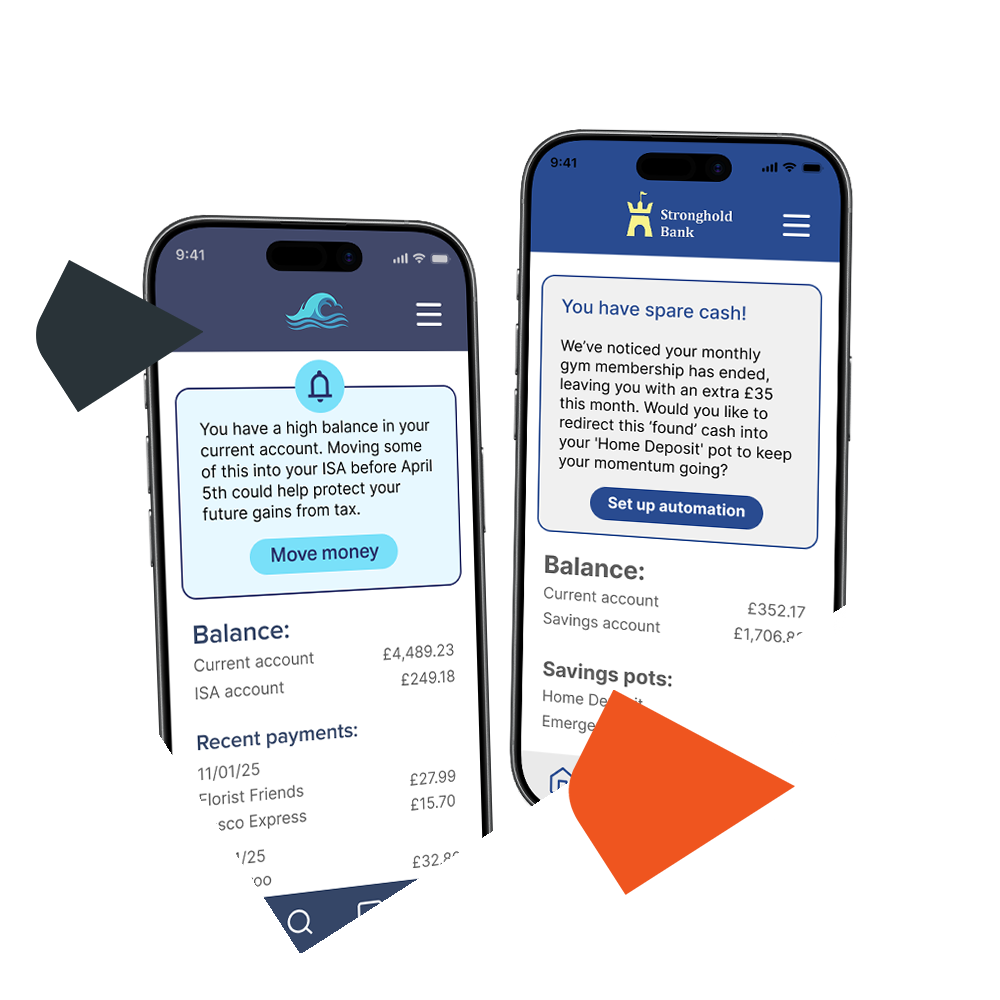
Standard Life, for example, opted to go live with Moneyhub-built solutions rather than consume an API-only integration. The collaboration saw strong engagement, with around 50% of Money Mindset users connecting additional accounts (significantly higher than the 12% average reported by competitors in the market) and 75% opening nudges.
For similar organisations that want to deliver impact fast, but without committing immediately to a full custom build, widgets can be a powerful middle ground and a much more realistic option.
What are the benefits of using widgets for pension providers?
Solutions that can be quickly embedded into a client’s own IT estate, like widgets, can typically be launched in under four weeks. They also require limited internal development effort required by the client.
It gives product and digital teams a more practical route to prove value without waiting for a major roadmap slot, putting useful journeys in front of members far more quickly.
This route also helps close the gap between strategy and delivery, giving internal champions something more powerful than a concept deck: a live proposition with visible outcomes.
This is why widgets can make such a strong internal business case.
They allow teams to:
- test a capability in a live environment
- learn from real member behaviour
- build confidence before moving into deeper integration work.
They can also lower delivery risk. Instead of asking colleagues to commit immediately to a long, expensive build, product and digital teams can position widgets as a practical first step. That makes internal approval easier, especially when stakeholders want proof before backing a broader programme and they want to see clear, increasing value delivery.
What we’ve seen successful rollouts get right
Drawing on our experience delivering Open Finance journeys for major pension providers (including Scottish Widows, Standard Life, Mercer and Legal & General), we’ve learned that:
- Building account connections should be the first priority, because it creates the data foundation that makes later journeys relevant to the individual member
- Insight-led tools then help providers show immediate member value and learn from live behaviour with lower delivery risk
- Payment journeys are then in a strong position to be effective at increasing funds under management, because members are more likely to act when the prompt is informed by their real financial position and arrives at the right moment
The reason for this clear sequencing approach is also partly practical: starting with connections also gives providers a lower-friction way to launch, learn from member behaviour, and build confidence before introducing more action-oriented journeys.
At that point, high-impact features like top-up journeys are not just another transactional feature. They are relevant, timely, and easier for the member to justify.

The provider is no longer simply asking the member for more money. It is creating the right conditions for action, at the right time for the member, by helping the individual understand what is affordable and why it matters now.
At that stage of maturity, pension providers start to become much more relevant to members. That matters because relevance and timing do not just improve the user experience; they also make positive contribution behaviour more likely.
Real-life example: additional voluntary pension contributions
For example, NEST Insight’s 2023 savings research confirms that saving from each pay packet towards a target helped build persistent saving habits, with evidence of savers rolling extra money into additional pension contributions once their savings target was reached.
In practice, there are several types of members who are more likely to be positive when managing their finances:
- a member who can see that payday is tomorrow
- that spending is under control
- or that a savings target is within reach
A member who also has a clear mechanism to act on that insight each payday is most likely to engage and make contributions to their pension.
These engagement experiences matter because they connect pensions to everyday financial life. Instead of asking members to care about retirement in isolation, they help them understand how short-term money management choices and long-term financial outcomes start to fit together.
Key Takeaway: too often, high-intent engagement moments are still treated as administrative tasks rather than valuable opportunities to drive action. Pension top-ups are a clear example. These journeys often introduce avoidable friction at exactly the moment a member is most ready to contribute. When embedded well, they do more than improve the member experience quickly: they create a more effective route from engagement to funded contribution, with clear upside for contribution volumes and funds under management.
Widgets can be the first step in a longer member engagement journey
The key delivery question is not whether a pension provider should choose whitelabel, widgets or APIs in the abstract. It is which route best solves the member problem in front of them, at the pace their organisation can realistically sustain. For many pension providers, widgets are the strongest answer when the goal is to move quickly, show value early and avoid waiting for perfect delivery conditions.
For many providers, the case comes down to five practical points:
- First, they reduce time to value. Time to launch is measured in days and weeks, not months or years.
- Second, they reduce delivery risk. Providers can test a proposition before committing to a larger custom build.
- Third, they improve member relevance. Connected, insight-led journeys help providers support members with real financial decisions, not just display pension information.
- Fourth, they create proof. Real usage, payment activity, and engagement data make future investment conversations easier.
- Fifth, they build toward a broader strategy. Widgets do not need to be the final destination. They can be the first practical step into a wider Open Finance proposition, with deeper integration over time where it makes sense.
The providers that build the strongest digital relationships with members will not necessarily be the ones with the biggest transformation programmes. They will be the ones that make useful journeys available sooner, prove what works and expand from a solid foundation. In pensions, progress does not always come from building everything at once: often, it comes from starting with the right thing, in the right order, and making it live before the moment of opportunity passes.
If you’re thinking about taking the first step into a new customer journey, we’d love to chat about whether widgets is the best deployment option for you, or whether another approach could be the most suitable.
Contact Moneyhub to discuss your options.
About Sarah Farrier
Sarah Farrier is a Product Manager at Moneyhub, whose career has been focused on data-heavy products operating in regulated environments. With an interest in working on products that solve complex problems at scale, and a particular curiosity about the potential of AI, one of Sarah’s career highlights has been the transformation of a banking onboarding process used by more than 30 million customers.
With a background in software engineering, it’s no wonder that Sarah also enjoys ongoing learning in her spare time. Most recently, she has taken on the challenge of building a new production-ready solution in a completely unfamiliar tech stack, with a self-imposed rule not to use any tool, platform or component she had worked with before.
share